
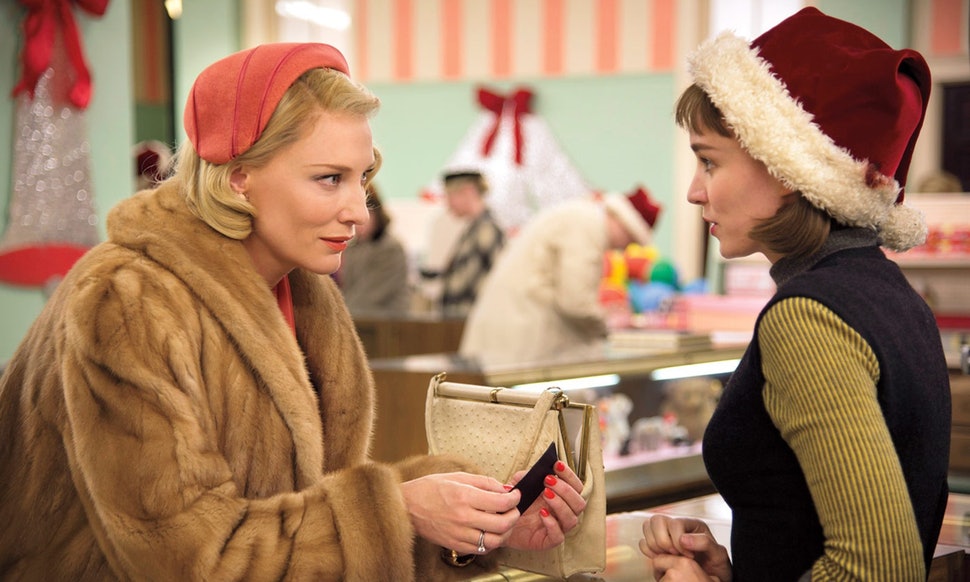
Carol is Todd Haynes’ adaptation of Patricia Highsmith’s controversial 1952 lesbian-romance novel. Carol (Cate Blanchett) is a soon-to-be-divorced housewife from the suburbs of New Jersey and Therese (Rooney Mara) is a young shop-girl who doesn’t know what she really wants out of life. She’s reactive and idealistically explores the world and loves photography. A few weeks before Christmas, Carol enters the shop and Therese is drawn to her. She watches Carol as she examines a child’s train set, one only hours before Therese had childishly admired herself. Then their eyes meet and the torture begins.
Carol intriguingly invokes Brief Encounter with its structure, opening at a future point in time and swirling its way back there, so when you see the opening scene with the knowledge of the film it is an achingly, heartbreaking brief hand touch of a sequence. You have to applaud Haynes, because invoking Brief Encounter, one of the best films ever made, is a brave thing to do, but it is done perfectly.
Blanchett acts with such purpose and fragility, in every scene her eyes show the true focus and you genuinely feel as though she deeply understands her character. She dominates the chemistry between her and Rooney Mara; but that’s not to say Mara is lacking in any way. Her performance is more understated and gentle, and goes beyond just serving the film.
Sarah Paulson is also great as playing Carol’s childhood friend and past lover. Although it wasn’t vital to the storyline, more exploration and development on the relationship between Carol (Blanchett) and Abby Gerhard (Paulson) would have been fascinating to explore. Although it will never happen, there could be a prequel to Carol, just about these two women because I feel it is sitting on something truly fascinating and defining of the period.
The film really plays on the chemistry the two lead actresses have together and I was just so swept with every scene they have alone together because it just feels so intimate! The themes of society telling them they can’t be together is prevalent in this film, but it is never the focus, it is simply a great coming of age romance between two people discovering themselves.
Todd Haynes has long been a director correlated to the LGBTQ community. His earlier film Far From Heaven features a similar exploration of forbidden love by a homosexual man in the 1950s. Carol subject matter obviously mirrors this in a lot of ways but his nods to members of the LGBTQ community and his care for them are admirable. Todd Haynes has been known for crafting beautiful imagery in his films, and it’s strikingly apparent in how Carol feels like a time capsule of its era and social climate.
The screenplay, by Phyllis Nagy, is smart, no character is outright evil, all are sympathetic and have their own problems. It’s so well done it’s easy to forget how progressive this film actually is. An LGBTQ+ film where the prejudice, the ‘quirky’ or ‘different’ aspects of such a relationship in the 1950’s etc. are not the sole power of the film, rather just their wonderful relationship and the obstacles they have to overcome.
The film is shot by Haynes’ usual cinematographer, the incomparable Edward Lachman. It’s shot in dark hues with bursts of saturation. It’s pure poetry. The production design and costuming aid Lachman’s already marvellous capturing of the 1950s. Haynes and Lachman captures the cold, distant nature of the time and thus of their relationship by keeping the intimacies far away. This distance is captured even more with Lachman’s use of blur and out-of-focus shots and it’s retracting to and from. Filmed in grainy 16mm with a somewhat muted colour palette, one has the sensation of going through old love letters and faded photos, total immersion in the time period and the melodrama.
As the film progresses not a lot happens, at least as much as traditionally one would suspect. It’s not an over-dramatic melodrama but there are stakes. The story is contained. It feels risky to keep it so contained but just as risky not to as well. To over-dramatise makes it unreal, to under-dramatise makes it realistic, makes it the 1950s
The editing is, aside from the revisited dinner scene, linear though incredibly well done both narratively and tonally. The progression of shots and the sequencing are reminiscent of memories, how, when recalling something you don’t remember exactly what it looked like, it could be blurry or out of focus, but the feeling is there. The cherry on top of the film is the score. Carter Burwell’s score hits all the right notes and truly highlights the setting and feelings of the film. This is a very cozy and warm film. The main theme is used lot but whenever its used it announces an important moment and is used very cleverly, I love the main theme, it’s a great piece of music. The rest of his score is fantastic and compliments the atmosphere very well. I liked how this film also features pre-existing songs from the 40’s and 50’s. Whenever those came on, I had a big grin on my face because it complimented the film very well.
Carol absolutely blew me away the first time I saw it, and it still holds up for me and even seems a better movie every time I re-watch it. It is filmmaking of the absolute highest order. For putting all of these incredible aspects together, and with some of the best direction I have ever seen, Todd Haynes makes what would be a charming love story into one of the greatest love stories ever told and one of the greatest films of not only the year, but is defiantly my favourite of all time. It’s everything I love about film, that it can take you to other eras, but also different dimensions and worlds that you would think only exist in dreams. Carol does both, and I am so thankful that it is real.
 Film Reviews by Chloe