
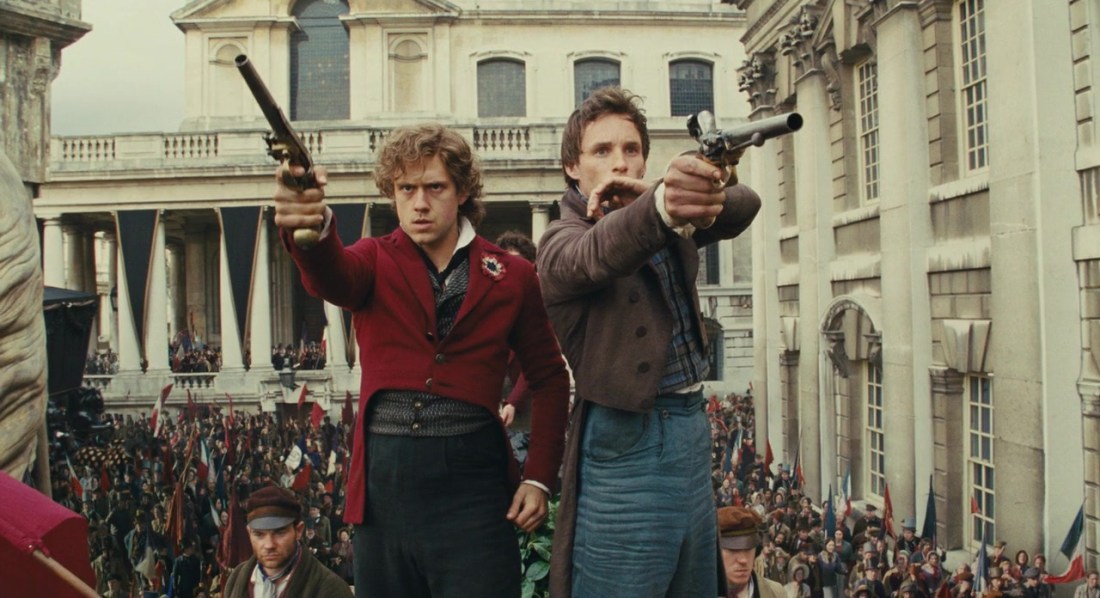
 Director Tom Hooper decides to take on an adaptation of the successful stage musical based on Victor Hugo’s classic novel set in 19th-century France. Les Misérables is a story set during the French Revolution and starts with Valjean (Hugh Jackman) in jail for 5 years because he stole some bread to save his sisters son with an additional 15 years because he tried to escape the law. Based on a French historical novel by Victor Hugo, first published in 1862, this novel has been turned into an award winning musical, with this film being just one of the renditions made. With stars like Anne Hathaway, Hugh Jackman and Russel Crow star this film gained a lot of attention prior to its release and had a lot riding on its success.
Being a musical, the first thing any fan hopes for is genuine singing that is full of emotion, and it delivered. All of the singing was recorded on set during the actual scenes when they were acting. The fact that it’s recorded on set as opposed to a recording studio means you are not getting the best possible vocal performance, but the emotion that it adds to the film is unreal, it’s what makes the film and the individuals acting Oscar worthy. Having Anne Hathaway crack a little on a note because her character is emotionally destroyed is ever much more impactful to me as a viewer then if she had sung perfectly or auto-tuned. It’s one of the reasons I think this is possibly Hathaway’s best performance of her career.
Hugh Jackman might have surprised me more than even Hathaway, even though his Broadway credentials clearly show his performance should have surprised no one. Russel Crowe is impressive as well. In the second half of the film we got to see the next generation in the film and in turn, a new generation of actors. Eddie Redmayne and Amanda Seyfried are both equally spectacular in their singing and acting but are still not on the level of Jackman and Hathaway, especially after Hathaway’s delivery of ‘I Dreamed a Dream’. The cast is what holds this film together, it’s a Pulp Fiction-tier cast.
Helena Bonham Carter and Sacha Baron Cohen bring in some much-needed comedy, as their characters really help to lighten the mood between constant scenes of despair, and they are absolutely hilarious every time they are on-screen together. What will really break your heart, though, is the relationship between Eddie Redmayne, Samantha Barks and Amanda Seyfried, who bring in the romantic side of the story. Eponine (Barks) is an amazing character, as it’s not often that you get to see a character from her own point of view. Her scenes bring a sense of reality and pure passion to the somewhat unreliable situation that the cast are in.
The production design is absolutely impeccable as it creates early 19th-century France, and right from its opening scene of hundreds of men hauling a ship into a dock, you know you’re watching something unprecedentedly massive. It’s not afraid of its size, and for an epic these days, it’s admirable.
And the cinematography by Danny Cohen seamlessly complements the harsh world of the poor France and the grand scale of the epic tale, using both crane shots and extreme close ups to do both.
Nevertheless, the editing was woeful, cutting every two seconds, only keeping too much attention on single shots of the singing performances while doing the minimal to establish scenery. The direction from Hooper is sloppy and lazy in parts. Still, you can’t fault it for the sheer look of the film because it looks gorgeous. The individual plot lines rub against each other but never really mix except for a few instances.
The addition of comedy and romance work amazingly well against the already compelling but deeply rooted story of hope and redemption, giving something for everybody to take away from the film. What draws you in even more, however, is the larger performances where whole groups of the cast come together. These songs work incredibly to make the audience feel a part of the revolution itself, especially with the final rousing chorus of “Do you hear the people sing?” This is a key quality of the film, completely drawing you in to every character and situation, as you are made to feel both uplifted by their actions but also drawn to tears because of the consequences. The nearing on three-hour length was almost a drag, but whilst it felt like you had seen the whole lives of these characters during these – although compacted – three hours, the length works as more of a positive as you are able to engage with the characters entirely. I thought sitting through the second half would allow to see a satisfying conclusion to Jackman and Crowe’s lengthy cat-and-mouse game, which is fairly arresting in the first half. But sadly even that great storyline whimpers in the latter half, ending unsatisfyingly after losing all its steam.
Either way, there is a great movie inside this, but it’s way-way too long for its own good and has no sense of pacing which makes a lot of parts in the film exhausting. What made me thoroughly enjoy the film was the overall focused directing, terrific acting, the beautiful songs, and the wonderful cinematography.
Les Misérables is heart-breaking, powerful, and inspiring. It is a triumphant film and an ideal cinematic visualisation of its West End/Broadway predecessor. It is, most importantly, one of the best movie musicals of the last 25 years, if not longer and it adds so much to the musical film community.
At two and a half hours of non-stop singing and its fair share of misery, this could be a bit much for some. But for me it is a remarkable achievement and a rewarding experience. By the end scene I was captivated by sorrow and joy as one, and if a film can do that to me then I class that as an amazing film.
 Film Reviews by Chloe